Quick Answer
Professional pest control can be safe for children, but safety depends on the product, the application method, and the precautions taken, not on pest control as a category. Regulatory guidance from the U.S. EPA and pediatric health bodies focuses on using registered products correctly, keeping children away from treated areas until it’s safe to return, and favoring integrated pest management (IPM) over routine spraying. This article covers what actually makes a treatment child-safe and what to ask before booking one.
Key Takeaways
- Pest control safety comes down to the product used, how it’s applied, and re-entry precautions — not whether a company calls itself “eco-friendly.”
- The EPA specifically recommends removing children, toys, and pets from treated areas until the product has dried or as the label directs.
- Integrated pest management (IPM), which combines non-chemical prevention with targeted treatment, is the approach pediatric health guidance favors over routine chemical spraying.
- “Child-safe” or “eco-friendly” marketing claims aren’t independently regulated terms; ask what’s actually used and how it’s applied, rather than relying on the label alone.
- Dubai Municipality approval confirms a company operates within the regulated framework, but it’s a licensing baseline, not proof that every treatment method is automatically appropriate for a home with young children.
What Actually Determines Safety
Pest control safety isn’t a single yes-or-no answer. It depends on three factors working together: the specific product used, how and where it’s applied, and what precautions the household takes during and after treatment.
The Product Itself
In the US, the EPA registers pesticides for specific uses and requires labels that state precautions, application instructions, and re-entry guidance. The Food Quality Protection Act specifically requires the EPA to apply an extra safety margin when assessing risk to infants and children, since children can be more sensitive to certain chemical exposures than adults. In the UAE, Dubai Municipality maintains its own approved pesticide list, and licensed companies are required to use products from that list rather than unregistered alternatives.
The Application Method
Even a properly registered product can pose a risk if it’s applied where children can touch it, in enclosed spaces without ventilation, or without the recommended drying or re-entry time. This is why application method matters as much as the product itself.
Household Precautions
The EPA’s guidance for reducing a child’s chance of pesticide poisoning recommends storing products out of reach, keeping children and toys away from treated areas until dry, and never transferring products into food or drink containers. These precautions apply whether treatment is done by a household member or a professional technician.
What Pediatric Health Guidance Recommends
The American Academy of Pediatrics (AAP) advises families to think about pest control through the lens of integrated pest management (IPM), rather than routine chemical spraying. IPM prioritizes non-chemical steps first: sealing entry points, removing food and water sources, and eliminating clutter that gives pests places to hide. When chemical treatment is genuinely necessary, the AAP recommends choosing less-toxic options and timing application for when children aren’t present.
This doesn’t mean chemical treatment is inherently unsafe. It means the sequence matters: prevention and targeted treatment first, broad chemical application only when needed, and always applied with children’s exposure specifically considered.
Comparison Table: What to Look For
| Factor | Lower-Risk Approach | Higher-Risk Approach |
|---|---|---|
| Method | Targeted, gel-based, or crack-and-crevice treatment | Broad-area spraying across open floor and surfaces |
| Product sourcing | Municipality-approved product list, technician can name the product | Unclear or unnamed products, no documentation offered |
| Timing | Scheduled when children can be out of the treated area | Applied with children present in the home |
| Re-entry guidance | Technician specifies a clear drying/re-entry time | No re-entry guidance given |
| Prevention component | Includes sealing entry points and source removal | Chemical treatment only, no prevention advice |
| Documentation | Technician explains what was used and why | Vague description like “our special formula” |
Checklist: What to Ask Before Booking
- What specific product or product category will be used, and is it on the Dubai Municipality-approved list?
- Is the treatment targeted (gel, bait, crack-and-crevice) or broad-area spraying?
- How long should children and pets stay out of the treated area?
- Does the plan include any non-chemical prevention steps, or is it chemical treatment only?
- Should toys, bedding, or food-prep surfaces be removed or covered before treatment?
- Does the technician hold a Dubai Municipality health card?
Expert Tip
Ask the technician to explain the treatment plan before it starts, not just confirm a booking time. A technician who can specifically describe the product, the method, and the re-entry timeline is following the same logic the EPA’s guidance recommends: informed precautions, not a vague safety claim. If a company can only offer general reassurance without specifics, that’s worth a follow-up question rather than an assumption.
Dubai-Specific Considerations
Dubai’s climate and building density affect which pests are common and how often treatment is needed, which indirectly affects a family’s overall pesticide exposure over time. Cockroaches and ants are frequent year-round concerns given the heat, while termite and rodent issues tend to follow humidity and construction activity nearby. Because many Dubai homes also run AC continuously, ventilation after an indoor treatment matters more than it might in a home with natural airflow through open windows. Ask specifically how long to keep the AC off, or whether the technician recommends running it on a higher setting to help clear residual vapor.
How Eco Guardians Approaches This
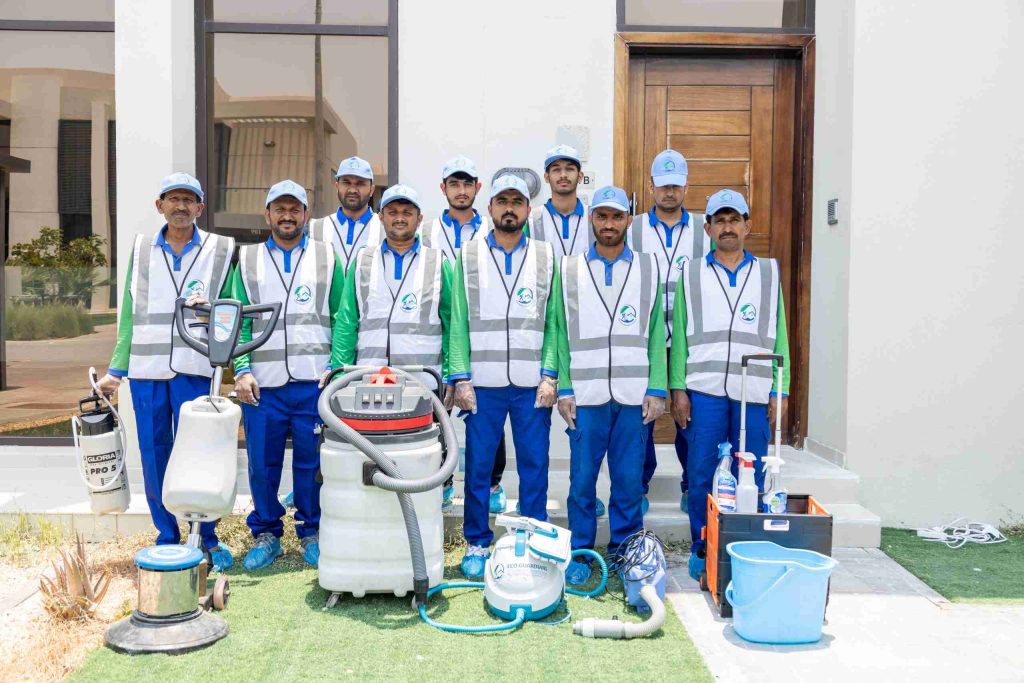
According to its website, Eco Guardians’ pest control services use products the company describes as environmentally friendly and safe for children and pets, applied by Dubai Municipality-approved technicians. For households with pets specifically, the company’s pet-friendly pest control guide covers preparation steps like removing food bowls and covering aquariums before treatment, much of which overlaps with reasonable precautions for children too. As with any provider, we’d still recommend asking the specific questions in the checklist above directly with your technician, since exact products and methods can vary by treatment type. If pest activity has also affected furniture or surfaces, furniture cleaning and disinfection services are worth pairing with treatment. We serve properties across Dubai, including Deira and JVC, with a full list on our locations page.
FAQ
General Safety Questions
Is professional pest control generally safer than DIY spray products? Often, yes, mainly because professional technicians typically use targeted application methods and follow label re-entry guidance more precisely than a household member using an over-the-counter spray without the same training.
Do I need to leave the house during pest control treatment? Not always. For targeted treatments like gel baits, leaving isn’t usually necessary. For broader spray applications, the EPA recommends keeping children and pets out of the treated area until it dries, which may or may not require leaving the property entirely depending on the treatment’s scope.
How long after treatment is it safe for children to return to a room? This varies by product and method, which is exactly why asking the technician for a specific re-entry time matters more than assuming a standard number. Follow the label or the technician’s stated timeline rather than a general rule of thumb.
Product and Method Questions
What does “eco-friendly pest control” actually mean? It isn’t an independently regulated term, so it can mean different things between companies. Ask what specific products are used and whether they’re on your local approved list, rather than relying on the label alone.
Is gel bait safer than spray treatment for homes with children? Generally, yes, since gel bait is applied in targeted, hidden locations rather than across open surfaces, which reduces the chance of a child touching treated areas directly.
Should I remove my child’s toys before a pest control visit? Yes. The EPA specifically recommends removing children, toys, and pets from the treatment area beforehand, which is a simple step that meaningfully reduces exposure risk.
Health and Symptom Questions
Can pesticide exposure cause symptoms in children even after a professional treatment? It’s possible if precautions aren’t followed correctly, though properly applied, correctly used registered products are designed to minimize this risk. If a child shows symptoms like unusual skin irritation, breathing difficulty, or nausea after treatment, contact a doctor or poison control promptly rather than waiting to see if it resolves.
Is it fine to use pest control if someone in the household is pregnant? This is a question worth raising directly with both the pest control provider and a doctor, since sensitivity to certain exposures can vary during pregnancy. It isn’t something a general article can safely answer for your specific situation.
Practical Questions
Does Dubai Municipality approval guarantee a treatment is child-safe? It confirms the company and its products meet the emirate’s regulatory requirements, which is meaningful, but it’s a baseline rather than a guarantee that every method used is automatically ideal for a home with young children. The specifics still matter.
How often should pest control be done in a home with young children? Frequency depends on the pest issue and prevention measures in place, not a fixed schedule tied to having children. A well-sealed, well-maintained home may need far less frequent chemical treatment than one with ongoing entry points, regardless of who lives there.