Quick Answer
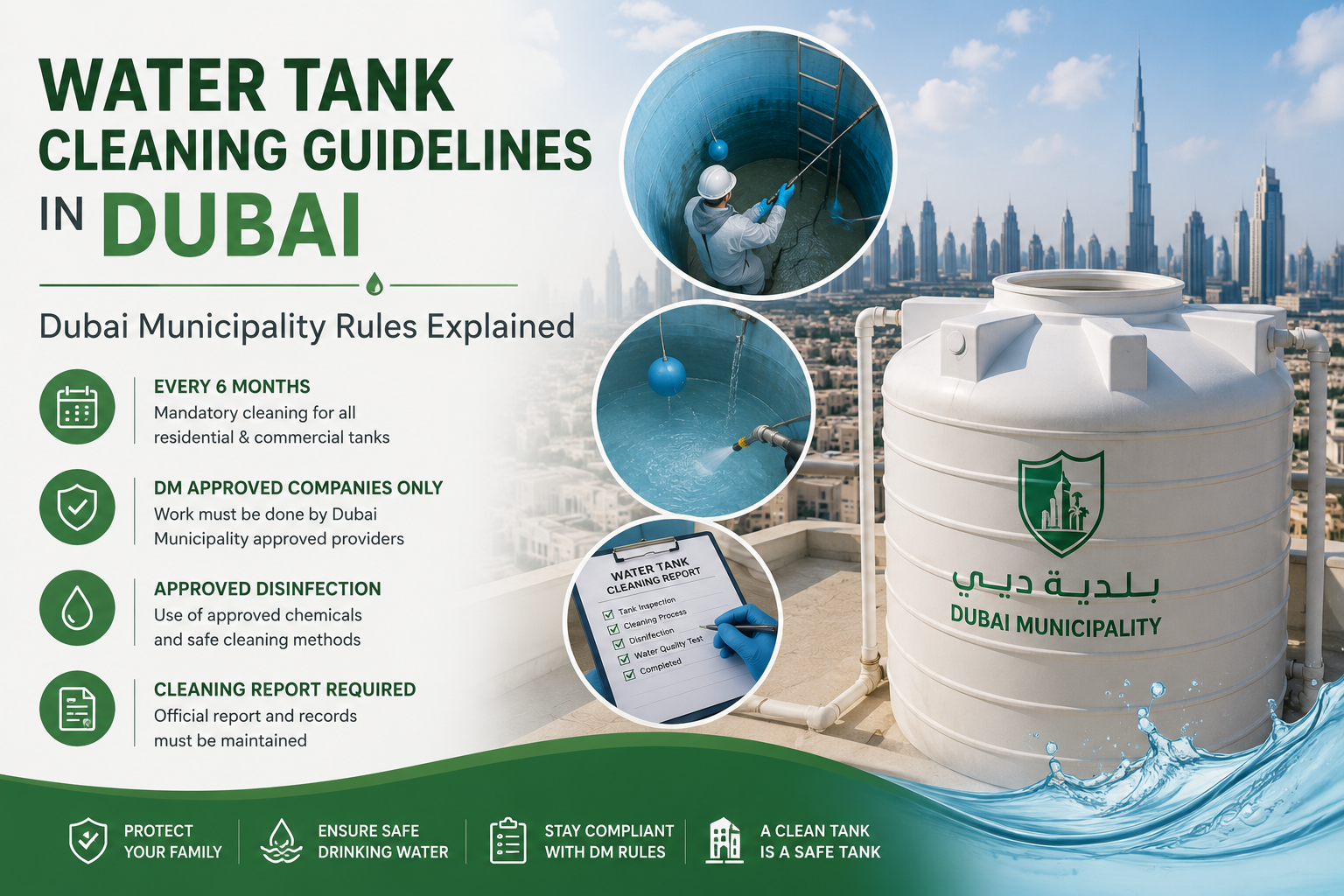
Water tank cleaning guidelines from Dubai Municipality set one clear rule. Every residential and commercial water storage tank in the emirate needs professional cleaning and disinfection at least once every six months. This applies to villas, apartments, and private tanks too, with no exemptions. A Municipality approved company must do the work. That company must use approved disinfection chemicals and record the job in a formal cleaning report. High risk premises such as schools, nurseries, hospitals, and food service facilities usually need more frequent cleaning, often quarterly. Property owners who skip the six month cycle risk fines, repeat inspections, and, in serious cases, restrictions on water use until they prove compliance.
Key Takeaways
- Water tank cleaning guidelines from Dubai Municipality set a mandatory minimum of once every six months for all residential and commercial tanks. This applies even to single family villas with private tanks.
- The cleaning company must hold active Dubai Municipality approval. A claim of experience on a company’s website does not equal a valid permit number.
- Dubai Municipality’s technical guideline for unbottled drinking water, document DM HSD GU17 DW2, sets out approval requirements, disinfection standards, and mandatory reporting for companies that clean and disinfect water tanks.
- A separate Dubai Municipality guideline on Legionella control in water systems requires cold water storage tanks to undergo emptying, cleaning, and disinfection at least every six months to reduce bacterial risk.
- Keep every cleaning report. Dubai Municipality inspections and building audits can request proof of the last service, the chemicals used, and the technician’s qualifications.
What Dubai Municipality Requires for Water Tank Cleaning
Dubai Municipality’s Health and Safety Department treats water tank hygiene as a public health issue, not a maintenance preference. Its Environmental Health Section oversees the rules. The core water tank cleaning guidelines cover four areas.
The four pillars of the guidelines
First, how often a tank needs cleaning. Second, who can perform the work. Third, which disinfection methods and chemicals count as acceptable. Fourth, what documentation the property owner must keep afterward. These requirements apply to villas, apartment towers, labor accommodations, schools, nurseries, hotels, and any commercial building that stores water for drinking, cooking, or general use.
Mandatory Cleaning Frequency by Property Type
| Property Type | Minimum Cleaning Frequency | Notes |
|---|---|---|
| Villas and standalone homes | Every 6 months | No exemption for private tanks, regardless of tank size |
| Apartment buildings and towers | Every 6 months | Facility management usually schedules this |
| Commercial offices and retail | Every 6 months | Higher occupancy may warrant more frequent servicing |
| Schools and nurseries | Quarterly recommended | Higher scrutiny due to child health sensitivity |
| Hospitals and clinics | Quarterly or more | Aligned with infection control protocols |
| Hotels and food service premises | Quarterly recommended | Directly tied to food safety compliance |
| Properties in dusty or coastal areas | Add extra cleaning after sandstorms | Fine particulate matter speeds up contamination |
Who Is Allowed to Clean Your Water Tank
Only a company approved by Dubai Municipality’s Food Safety Department can legally clean and disinfect a water tank in Dubai. Many property owners misunderstand this part of the water tank cleaning guidelines. They assume any cleaning company can do the job, but that isn’t true. An approved provider can show a valid permit number on request. That number should also appear on the cleaning report.
DIY cleaning does not satisfy the compliance requirement, even if the tank ends up looking clean. The same applies to hiring an unlicensed handyman for the job.
DM Approved Company Checklist
- Ask for the company’s Dubai Municipality permit number before booking, not after the job is done
- Confirm the technicians use approved disinfectants, typically chlorine based solutions
- Request a written cleaning report that names the date, method, chemicals, and technician
- Ask whether pre and post cleaning water quality testing is included, covering pH, TDS, and chlorine residual
- Check that the company can produce before and after photos of the tank interior
- Confirm the report includes the permit number so you can present it during a building inspection
What a Compliant Cleaning Report Should Include
| Element | Why It Matters |
|---|---|
| Exact date and time of cleaning | Establishes when the six month clock resets |
| Chemicals used, including name and concentration | Confirms the technician applied approved disinfectants correctly |
| Cleaning method | Shows the technician followed draining, scrubbing, and disinfection steps |
| Technician identity and company permit number | Proves an approved provider did the work |
| Pre and post cleaning water quality results | Demonstrates the tank met safety standards after service |
| Photos of the tank before and after | Provides visual evidence for audits or disputes |
Step by Step: What a Proper Water Tank Cleaning Involves
A compliant cleaning follows a clear sequence.
- The technician drains the tank completely and directs wastewater to an appropriate drain
- The team removes sediment, sludge, and any visible debris from the tank base and walls
- The crew scrubs and, where needed, pressure washes internal surfaces
- The technician applies an approved disinfectant and allows the correct contact time before rinsing
- The team flushes the tank thoroughly to remove all chemical residue
- Workers refill the tank with fresh water and, where required, test water quality before it returns to use
- The company issues a written cleaning and disinfection report with technician and company details
Why This Matters Beyond Compliance
An overlooked water tank creates health risks, not just a failed inspection. Sediment and biofilm buildup can harbor Legionella, the bacteria responsible for a severe form of pneumonia. Dubai Municipality’s own Legionella control guideline for water systems specifically requires cold water storage tanks to undergo emptying, cleaning, and disinfection at least every six months for exactly this reason. Dubai’s climate raises the stakes too. High ambient temperatures and dust accumulation can speed up bacterial growth and sediment buildup between cleaning cycles.
Dubai Specific Considerations for Property Owners
Coastal and humid communities
Coastal and high humidity communities such as Dubai Marina and areas near the creek see faster biofilm growth in rooftop tanks. Facility managers in these communities often schedule cleaning slightly ahead of the six month deadline rather than waiting until it hits.
Dust prone areas
Villas in dust prone communities, including areas near Al Barsha, Mirdif, or the desert margins, should plan an extra inspection after major sandstorms. Fine sand can work into tank seals and speed up contamination even between scheduled cleanings.
After renovation work
Buildings undergoing renovation should schedule a tank check after any plumbing or rooftop work. Disturbed lids or pipework can introduce debris that a routine six month cycle was not designed to catch.
Cost Guide for Compliant Water Tank Cleaning in Dubai
| Property Type | Typical Price Range (AED) |
|---|---|
| Residential apartment tank | 300 to 750 |
| Villa tank | 600 to 1,500 |
| Commercial or large tank system | 2,000 to 8,000 or more |
Prices depend on tank size, accessibility, whether the tank sits underground or overhead, and whether the service includes water quality testing. A fixed quote against your specific tank always beats a generic starting price.
Property Owner Compliance Checklist
- Confirm your tank’s last cleaning date falls within the past six months, and book ahead of the deadline rather than waiting for it
- Verify your provider’s Dubai Municipality permit before booking
- Request and store the written cleaning report after every service
- Keep at least the last two cleaning reports on file in case a building inspection asks for history
- Add a calendar reminder for the next cleaning cycle so the six month window never lapses unnoticed
- Schedule an additional check after major renovation work, plumbing repairs, or severe sandstorms
Expert Tips
Set a recurring reminder rather than relying on memory. Dubai Municipality treats the six month window as a legal minimum, not a flexible guideline. Ask your provider directly whether water quality testing forms part of the service, since a visibly clean tank can still fail a chlorine residual or bacterial test. If your building uses a shared facility management company, confirm in writing which party handles tank cleaning scheduling. Disputes over this responsibility happen often in shared apartment towers. Villa owners with older concrete tanks should budget for slightly more frequent servicing. Concrete is more porous than plastic or fiberglass, and it tends to hold mineral deposits that support bacterial growth.
Frequently Asked Questions
1. What are the water tank cleaning guidelines set by Dubai Municipality? Dubai Municipality requires professional cleaning and disinfection of all residential and commercial water tanks at least once every six months. A Municipality approved company must do the work, and property owners must keep documentation for each service.
2. Is water tank cleaning mandatory in Dubai, or just recommended? It is mandatory. Dubai Municipality treats the six month interval as a legal minimum. Non-compliance can lead to fines and repeat inspections rather than staying an optional maintenance task.
3. How often should a residential water tank be cleaned in Dubai? At minimum every six months. Villas with concrete tanks, properties in dusty areas, or buildings with heavy water usage may benefit from more frequent cleaning, though six months remains the enforced baseline.
4. Can I clean my own water tank instead of hiring a professional? No. Dubai Municipality requires an approved, licensed contractor to do the work using approved disinfectants. DIY cleaning does not satisfy the compliance requirement, even when performed carefully.
5. How do I check if a water tank cleaning company is approved by Dubai Municipality? Ask the company directly for its Dubai Municipality Food Safety Department permit number. Request that this number appear on your written cleaning report so you have it on file.
6. What happens if I do not clean my water tank on schedule? Non-compliance can result in fines, additional required inspections, and, in serious cases, restrictions on water use until you prove the tank has been cleaned and disinfected properly.
7. What documents should I keep after a water tank cleaning service? Keep the written cleaning report. It should show the date, chemicals used, cleaning method, technician details, the company’s permit number, and, where available, pre and post cleaning water quality test results.
8. Does Dubai Municipality require water quality testing after cleaning? Testing is increasingly expected, particularly for commercial buildings. It confirms the tank is free of bacteria, chemical residue, and other contaminants before use resumes.
9. How much does water tank cleaning cost in Dubai? Residential tanks typically cost AED 300 to 750, villa tanks AED 600 to 1,500, and commercial tanks AED 2,000 to 8,000 or more, depending on size and accessibility.
10. Why does water tank cleaning matter beyond passing an inspection? Neglected tanks can develop sediment and biofilm that harbor bacteria such as Legionella. This is why Dubai Municipality’s Legionella control guideline for water systems separately requires cold water tanks to undergo cleaning at least every six months.
11. Are schools and hospitals held to a different standard than homes? Yes. High risk premises such as schools, nurseries, hospitals, and food service facilities generally clean more often, usually quarterly, given the higher sensitivity of the people using the water.
12. Do apartment towers or the individual tenant handle water tank cleaning? In most apartment buildings, the facility management company or building owner schedules tank cleaning. Tenants in villas or smaller private properties usually handle it themselves.
13. Does concrete or plastic tank material affect the cleaning schedule? Concrete tanks are more porous and prone to mineral buildup than plastic or fiberglass tanks. Some property owners choose to clean concrete tanks slightly more often, though six months remains the enforced minimum.
14. Should I clean my tank after a sandstorm or major renovation? Yes, it’s worth doing. Sandstorms can introduce fine dust into tank seals, and renovation work near rooftop tanks or pipework can disturb lids or introduce debris. Both can compromise water quality between scheduled cleanings.
15. Where can I find the official Dubai Municipality guidelines for water tanks? Dubai Municipality publishes technical guidelines through its Health and Safety Department. These include the technical guideline for unbottled drinking water quality and a separate guideline on Legionella control in water systems, both available on the Dubai Municipality website.
Related Eco Guardians Services
Eco Guardians’ own guide to the best water tank cleaning company in Dubai walks through how to choose a provider. The core water tank cleaning service in Dubai page covers the inspection and disinfection process in detail. Readers in specific communities can also see how the service works locally through the water tank cleaning in Dubai Marina page and the water tank cleaning in Dubai Silicon Oasis page. Abu Dhabi residents can find the equivalent water tank cleaning in Abu Dhabi service.
Bacterial risk and general hygiene often go hand in hand, so it’s worth pairing a compliant tank cleaning with disinfection and sanitization services. Where AC systems are involved, consider AC duct cleaning too. Property owners dealing with a wider pest or hygiene issue alongside a water tank problem can review pest control services in Dubai. For background on the company’s certifications, visit the About Eco Guardians page, or go straight to booking a fixed quote for your property.
Sources and Further Reading
- Dubai Municipality Technical Guidelines for Quality of Unbottled Drinking Water, DM HSD GU17 DW2
- Dubai Municipality Technical Guidelines for Legionella Control in Water Systems, DM HSD GU44 LCWS2
- Dubai Municipality
This article offers general guidance and does not replace the official Dubai Municipality technical guidelines. Always confirm current requirements directly with Dubai Municipality or a Municipality approved provider before scheduling service. To book a compliant water tank cleaning, contact Eco Guardians or call +971 56 752 6970.