Quick Answer
The seven warning signs of a termite infestation in Dubai are: mud tubes on walls or foundations, hollow-sounding wood, discarded wings near windows and lights, termite droppings (frass) that look like sawdust, blistering or bubbling paint, doors and windows that suddenly stick, and sagging skirting boards or ceilings. Dubai’s heat, humidity, irrigated landscaping, and heavy use of wooden doors, wardrobes, and skirting make villas and ground-floor units especially exposed. If you notice two or more of these signs together, stop DIY spraying and book a professional inspection subterranean termite colonies live underground and keep feeding even after the visible symptom disappears.
Key Takeaways
- Termites in Dubai are almost always the subterranean type, which needs soil contact and moisture irrigation, AC condensation lines, and garden beds against the villa wall are the biggest risk factors.
- Early signs (a few discarded wings, a faint hollow sound) are easy to dismiss as dust or wear. By the time paint blisters or floors sag, damage is already structural.
- A single termite sighting indoors is reason enough for a professional inspection colonies can number in the hundreds of thousands and rarely announce themselves loudly.
- Dubai Municipality requires termite treatment to be carried out by a licensed, municipality-approved pest control company using approved chemicals DIY sprays from the supermarket do not reach the colony.
- Post-construction termite treatments in Dubai typically carry warranties of several years, so ask for documentation, not just a verbal promise.
Why Dubai Homes Are Particularly at Risk
Termites need three things to thrive: warmth, moisture, and cellulose (wood, paper, cardboard). Dubai’s climate supplies the first two almost year-round high humidity along the coast, warm soil temperatures, and villa compounds with irrigated lawns, hedges, and timber landscaping features sitting right against the building. The third condition, cellulose, is everywhere inside a typical Dubai home: timber door frames, built-in wardrobes, kitchen cabinets, wooden flooring, false ceilings, and even the cardboard boxes stacked in a storeroom.
Many residents assume termites are only a risk for older or fully wooden properties. In reality, concrete-and-block villas across Dubai Marina, The Meadows, Jumeirah Village Circle, and older communities in Deira and Sharjah still contain plenty of termite food sources, and irrigation systems near the foundation create exactly the moist soil-to-wood contact subterranean termites need to build a colony.
The 7 Warning Signs of Termite Infestation (Explained)
1. Mud Tubes on Walls, Foundations, or Garden Walls
Subterranean termites build pencil-thin tunnels out of soil, saliva, and wood particles to travel between their underground colony and a food source while staying protected from open air and predators. Look along:
- External foundation walls, especially the shaded side of the villa
- Garden or boundary walls where soil meets brickwork
- The base of wooden fences, pergolas, or landscaping timber
What it means: An active mud tube is one of the clearest, most diagnostic signs of subterranean termite activity far more reliable than any other sign on this list, because ants and other insects don’t build these structures.
2. Hollow-Sounding Wood
Termites eat wood from the inside out, often leaving a thin, intact outer layer that hides the damage until you tap it. Test door frames, skirting boards, wooden flooring, and built-in wardrobes with the back of a spoon or your knuckle.
What it means: A dull, papery, or hollow sound instead of a solid thud suggests the wood has already been extensively tunnelled this is a later-stage sign, not an early one.
3. Discarded Wings Near Windows, Doors, and Light Fixtures
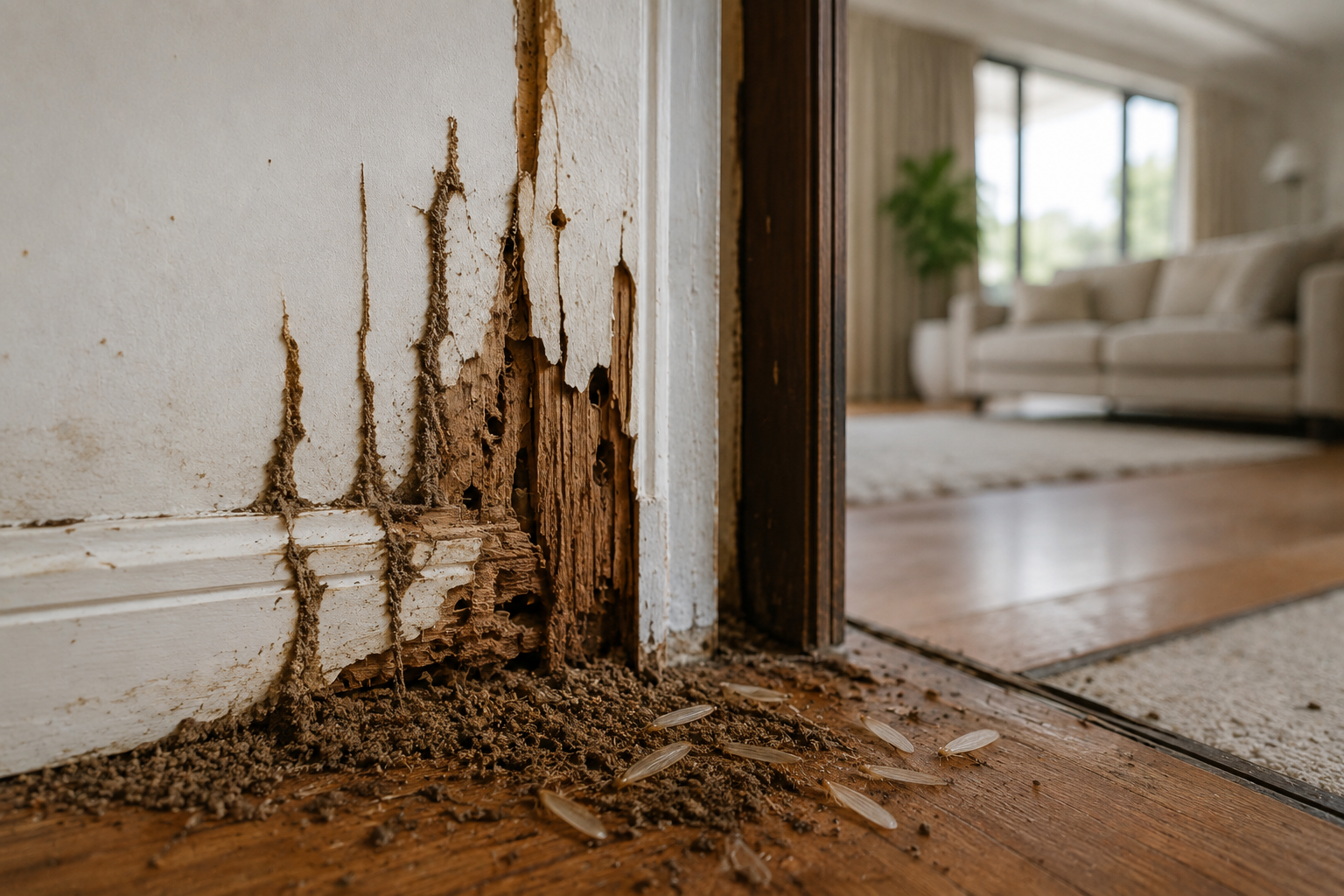
Mature colonies release winged reproductives (“swarmers” or “alates”) that fly out to start new colonies, then shed their wings once they land. Piles of small, uniform, translucent wings on a windowsill or under a light fixture are a strong indicator.
Expert tip: Termite swarmers are frequently confused with flying ants. Termite wings are equal in length and the body shows no pinched waist; flying ants have unequal wing pairs and a distinct narrow waist. If you’re unsure which one you’re looking at, photograph it before cleaning it up so a technician can identify the species.
4. Frass (Termite Droppings) That Look Like Sawdust or Coffee Grounds
Drywood termites less common in Dubai than subterranean termites but still found in furniture and imported wood items push their droppings out of small “kick-out holes.” These pellet-like grains accumulate in small mounds beneath furniture, window frames, or wooden decor.
5. Bubbling, Blistering, or Peeling Paint
Because termites tunnel just under painted or varnished wood surfaces, the moisture and disturbance they create can mimic water damage bubbling paint, warped skirting, or a slightly rippled texture on a wooden door. Many Dubai homeowners initially blame this on humidity or AC condensation, delaying inspection by months.
6. Doors and Windows That Suddenly Stick
Termite tunnelling and the moisture that comes with it can warp wooden frames just enough that a door or window that used to close easily now sticks or drags. If you haven’t changed the hardware and the sticking appeared gradually, structural wood damage is worth ruling out.
7. Sagging Skirting Boards, Floors, or Ceiling Panels
This is the most advanced and most expensive sign. By the time skirting boards sag, wooden flooring feels spongy, or a false ceiling panel visibly dips, the termites have been active for a significant period and structural wood has lost load-bearing strength.
Signs Comparison Table: How Urgent Is Each Sign?
| Sign | What It Usually Means | Urgency Level | Recommended Action |
|---|---|---|---|
| Mud tubes | Active subterranean colony nearby | High | Book inspection within 48 hours |
| Hollow-sounding wood | Internal tunnelling already underway | High | Book inspection within 48 hours |
| Discarded wings | Mature colony has recently swarmed | High | Book inspection this week |
| Frass / droppings | Active drywood termite feeding | Medium–High | Book inspection this week |
| Blistering paint | Early-to-mid tunnelling near the surface | Medium | Monitor and book inspection |
| Sticking doors/windows | Wood warping from moisture/tunnelling | Medium | Monitor and book inspection |
| Sagging floors/ceilings | Advanced structural damage | Critical | Same-day professional assessment |
Subterranean vs. Drywood Termites in the UAE
| Feature | Subterranean Termites (most common in Dubai) | Drywood Termites (less common, found in furniture/imported wood) |
|---|---|---|
| Where they live | Underground colonies, connected to wood via mud tubes | Entirely inside the wood they infest |
| Moisture need | Requires constant soil contact and moisture | Can survive in dry wood with minimal moisture |
| Typical entry point | Foundation, garden walls, irrigation lines | Imported furniture, wooden decor, roof timber |
| Visible sign | Mud tubes | Frass (pellet droppings) pushed out of kick-out holes |
| Treatment approach | Soil treatment, bait stations, liquid termiticide barrier | Localized wood treatment or full fumigation for severe cases |
Self-Inspection Checklist for Dubai Homeowners
Use this checklist every three to six months, especially before and after the summer humidity peak:
- Walk the full perimeter of the villa and check foundation walls for mud tubes
- Tap wooden door frames, skirting, and flooring in at least five locations
- Check windowsills and light fixtures for discarded wings, particularly after rain or heavy watering
- Inspect under sinks and around AC condensation drains for excess moisture against wood
- Look inside built-in wardrobes and kitchen cabinets for small holes or fine dust
- Check storeroom cardboard boxes and any wood stored directly on soil or against the wall
- Note any doors or windows that have started sticking in the last few months
- Photograph anything suspicious and note the date, so you can track changes over time
Expert Tips for Termite Prevention in Dubai’s Climate
- Keep irrigation heads and sprinklers away from the foundation. Constant dampness against the base of the wall is the single biggest driver of subterranean termite activity in Dubai villas.
- Store firewood, timber, and cardboard off the ground and away from exterior walls. Direct wood-to-soil contact is effectively an open invitation.
- Fix AC condensation leaks quickly. Indoor units that drip near wooden flooring or skirting create a moisture pocket that mimics outdoor conditions termites need.
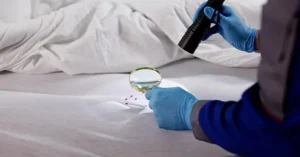
- Don’t rely on visible inspection alone. Termites tunnel behind paint, tiles, and plaster, so a trained technician using moisture meters and, where needed, borescopes will catch damage a homeowner’s walk-through misses.
- Schedule a professional inspection every 12 months, even without visible signs colonies can be active for a year or more before symptoms become obvious.
What Happens During a Professional Termite Inspection
A thorough inspection typically covers:
- Perimeter check of the foundation, garden walls, and any wood-to-soil contact points
- Interior inspection of door frames, skirting, built-in wardrobes, kitchen cabinets, and wooden flooring
- Moisture assessment near bathrooms, kitchens, and AC units
- Roof and false-ceiling check in villas with timber structural elements
- A written report with a treatment plan tailored to whether the issue is subterranean, drywood, or both
Eco Guardians’ termite control service in Dubai includes a free property inspection, pre-construction and post-construction treatment options, and a multi-year warranty backed by Dubai Municipality approval.
Pre-Construction vs. Post-Construction Termite Treatment
| Treatment Type | When It’s Used | What It Involves |
|---|---|---|
| Pre-construction | Before flooring/foundation is laid, for new builds or major renovations | Soil treatment barrier applied before slab and foundation work |
| Post-construction | For existing homes with an active or suspected infestation | Drilling and injecting termiticide around the foundation, plus targeted treatment of affected wood |
DIY vs. Professional Treatment: Why DIY Sprays Fall Short
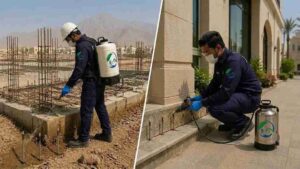
Supermarket insect sprays kill the termites they directly contact but do nothing to the colony, which can hold hundreds of thousands of individuals underground. Professional treatment targets the colony itself through soil barriers or bait systems, which is the only approach that stops new termites from continuously replacing the ones you can see. Dubai Municipality also requires licensed technicians to handle and apply termiticides, since improper use of unregulated chemicals indoors carries real health risks for residents and pets.
Frequently Asked Questions
1. What are the first signs of termites in a Dubai villa? The earliest signs are usually a few discarded wings near a window or light fixture, or a faint hollow sound when you tap a wooden door frame both are easy to miss because they don’t look dramatic at first.
2. Are termites common in Dubai? Yes. Dubai’s warm, humid climate and the widespread use of irrigation around villas create favorable conditions for subterranean termites, which is why regular inspection is recommended even in relatively new properties.
3. How can I tell the difference between termites and flying ants? Termite swarmers have two pairs of wings of equal length and a straight, thick waist. Flying ants have unequal wing pairs and a narrow, pinched waist. Termite antennae are straight; ant antennae are bent.
4. Can termites damage a concrete villa? Termites don’t eat concrete, but Dubai villas built with concrete still contain large amounts of wood door frames, wardrobes, cabinets, skirting, and flooring all of which are vulnerable.
5. How much does termite treatment cost in Dubai? Cost depends on property size, the extent of the infestation, and whether pre-construction or post-construction treatment is required. Most companies, including Eco Guardians, offer a free inspection first so you get an accurate quote before committing.
6. Is termite treatment safe for children and pets? Municipality-approved termiticides are tested and regulated for residential use when applied by licensed technicians following the manufacturer’s safety guidelines, which typically include a re-entry waiting period.
7. How long does termite treatment take to work? Liquid soil treatments usually create an immediate barrier, while bait systems can take a few weeks to a few months to eliminate an entire colony, since worker termites carry the bait back to the nest.
8. Do I need a termite inspection before buying a villa in Dubai? It’s strongly recommended, particularly for older properties or homes with extensive timber landscaping, since termite damage isn’t always visible during a standard walkthrough.
9. How often should I schedule termite inspections? Once every 12 months is a reasonable baseline for most Dubai properties, with more frequent checks recommended for villas with gardens, irrigation systems, or a history of termite activity.
10. What time of year are termite swarms most common in the UAE? Swarming activity tends to increase after rainfall and periods of higher humidity, when winged reproductives leave the colony to establish new ones keep an eye out for discarded wings during and shortly after the cooler, wetter months.
11. Can I treat termites myself with store-bought spray? Store-bought sprays only kill the termites they touch and don’t reach the underground colony, so they rarely solve the underlying problem and can even scatter the colony into new areas of the property.
12. Is Eco Guardians approved by Dubai Municipality for termite control? Yes Eco Guardians is a Dubai Municipality-approved pest control provider offering both pre-construction and post-construction termite treatment with a multi-year warranty.
13. What should I do if I find just one termite indoors? Treat it as a warning sign rather than an isolated incident. A single indoor termite sighting often means a scout has found a food source and reported back to the colony, so it’s worth booking an inspection rather than waiting for more visible damage.
Related Eco Guardians Services
If a termite inspection uncovers other pest activity, or if repairs are needed after treatment, these related services can help:
- Termite Control in Dubai free inspection, pre- and post-construction treatment, multi-year warranty
- Ant Pest Control Dubai for flying ants often confused with termite swarmers
- Handyman Services for repairing sticking doors, warped frames, and damaged skirting
- Civil Maintenance Services for structural repairs after significant termite damage
- Pest Control Services in Dubai the full range of residential and commercial pest control
Sources and Further Reading
- US EPA — Termites: How to Identify and Control Them
- Dubai Municipality — Public Health Pest Control Section
- National Pest Management Association — Termite Resources
This article is for general information and does not replace a professional property inspection. For a free termite inspection in Dubai, book an appointment with Eco Guardians or call +971-56-752-6970.