Quick Answer
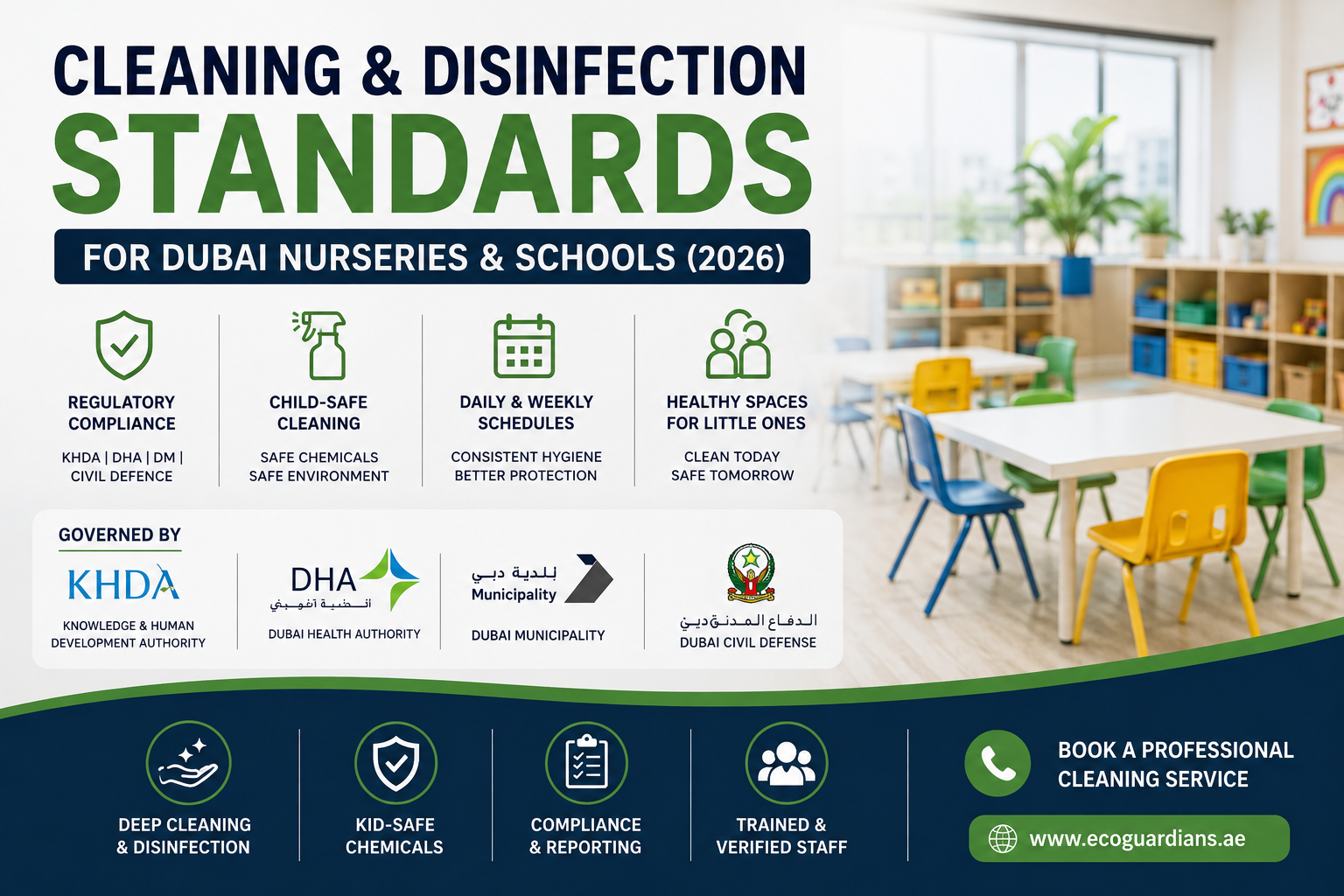
Dubai nurseries and schools sit under four overlapping authorities: KHDA sets the education permit and premises safety requirements, including hazard-free storage of cleaning materials. DHA governs the health and clinic side of nurseries through its Standards for Clinics in Nurseries and Early Learning Centers. Dubai Municipality issues cleaning and disinfection guidelines that apply across schools, food areas, and general premises hygiene. Civil Defence covers building safety standards that intersect with storage and ventilation. In practice, this means a compliant facility needs a documented cleaning schedule, safer disinfectant products with low fragrance and low toxicity, locked chemical storage away from children, and a clear split between sanitizing (for anything a child might put in their mouth) and disinfecting (for surfaces and high-touch points). Eco Guardians builds nursery and school cleaning programs around this exact framework.
Key Takeaways
- Four Dubai authorities intersect on nursery hygiene: KHDA, DHA, Dubai Municipality, and Civil Defence. Each covers a different part of compliance, and a facility needs to satisfy all four, not just one.
- Cleaning, sanitizing, and disinfecting are not interchangeable terms. The CDC’s guidance on early care settings treats them as three distinct steps with different products and different uses.
- Items children put in their mouths, such as toys and feeding equipment, should be sanitized with a food-contact sanitizer, not treated with a standard surface disinfectant.
- KHDA’s premises standards explicitly require hazard-free storage of cleaning materials, which means locked, out-of-reach storage is a compliance point, not just good practice.
- Safer disinfectant active ingredients recognized by the EPA include hydrogen peroxide, citric acid, L-lactic acid, and ethanol. These reduce asthma and irritation risk compared to harsher alternatives.
- A working nursery cleaning program needs daily, weekly, and termly layers, not a single flat schedule applied everywhere.
Which Authority Regulates What
This is the part most guides skip, and it is the single most useful thing to understand before setting up a cleaning program.
| Authority | What It Governs |
|---|---|
| KHDA | Education permit, premises safety, staff clearances, and hazard-free storage of hazardous materials including cleaning chemicals |
| DHA | Health and clinic requirements inside nurseries, including the nurse-staffed clinic room and illness isolation protocols |
| Dubai Municipality | General cleaning and disinfection guidelines, food safety, and premises hygiene inspections |
| Civil Defence | Building safety standards that affect chemical storage, ventilation, and general facility safety |
A nursery cannot legally operate without both its KHDA education permit and DHA clinic sign-off. Cleaning and disinfection sit across all four bodies depending on the area of the facility, which is why a single generic cleaning contract often misses requirements that a nursery-specific program would catch.
Clean, Sanitize, or Disinfect: Why the Difference Matters
Most cleaning guidance for adult environments treats these terms loosely. In a nursery or school, the difference has real consequences for child safety. According to the U.S. CDC’s guidance on early care and education settings, cleaning removes dirt and some germs using soap and water, sanitizing reduces germs to a safe level, and disinfecting kills germs on surfaces using a registered product. See the CDC’s guidance on cleaning and disinfecting early care and education settings.
The practical rule that follows from this: items a child might put in their mouth, such as toys, teethers, and feeding items, should be sanitized with a food-contact sanitizer or run through a dishwasher, never treated with a standard surface disinfectant. Disinfectants are formulated for hard, non-porous surfaces and are not designed to be mouthed.
Choosing Safer Cleaning Chemicals for Child Environments
Not every EPA-registered disinfectant is equally suitable for a room full of young children. The EPA has identified a set of active ingredients as safer choices for sensitive environments, including hydrogen peroxide, citric acid, L-lactic acid, ethanol, and isopropanol. Products using these ingredients carry a lower risk of triggering asthma or skin and eye irritation compared to harsher formulations. When selecting a provider, ask directly which active ingredients they use rather than accepting a general claim of being eco-friendly.
Practical selection criteria for a nursery or school:
- Fragrance-free or low-fragrance formulations, since strong scents are a common asthma and sensory trigger for young children
- EPA-registered or equivalent certification, with the registration number available on request
- Products safe for use in occupied spaces once dried, so classrooms are not out of use longer than necessary
- Separate food-contact sanitizers for toys, feeding equipment, and anything mouthed
Zone-Based Cleaning: Why One Protocol Doesn’t Fit the Whole Facility
A nursery is not one uniform space. Different zones carry different risks and need different protocols, similar to how a hotel separates guest rooms from kitchens.
| Zone | Cleaning Frequency | Special Requirement |
|---|---|---|
| Classrooms and play areas | Daily, plus spot cleaning as needed | Toys and mouthed items sanitized separately from surfaces |
| Nappy changing areas | After every use | Dedicated disinfectant, never shared cloths with other zones |
| Food preparation and dining | Before and after every meal service | Food-contact sanitizers only, aligned with Dubai Municipality food hygiene rules |
| Restrooms | Multiple times daily | Standard disinfection, closely tracked given high-touch surface count |
| Clinic or isolation room | After every use, especially post-illness | Aligned with DHA clinic protocols for infectious illness isolation |
Using a single cloth or mop across these zones is one of the most common compliance and hygiene failures in facilities that treat cleaning as one undifferentiated task rather than a zoned system.
Chemical Storage: A Compliance Point, Not Just Good Practice
KHDA’s premises standards call for hazard-free storage of cleaning materials as part of a nursery’s physical safety requirements. This means locked storage, out of reach of children, with Safety Data Sheets available for every product on site. This is worth treating as a checked compliance item during any inspection preparation, not an informal housekeeping habit left to individual staff discretion.
A Working Daily, Weekly, and Termly Schedule
Daily
- Wipe down and sanitize high-touch surfaces: door handles, light switches, tables, and shared equipment
- Sanitize toys and mouthed items at the end of each session
- Clean and disinfect nappy changing areas after every use
- Clean and sanitize food preparation surfaces before and after each meal
Weekly
- Deep clean carpets, rugs, and soft furnishings
- Launder soft toys and fabric play items
- Disinfect storage cubbies and shared cabinets
Termly
- Full deep clean of the facility during school holidays, covering areas not accessible during term time
- Review and restock chemical supplies, checking expiry dates
- Refresh staff training on cleaning protocols and chemical safety
Outbreak and Illness Response
When a confirmed illness case occurs, standard daily cleaning is not sufficient. The affected area should be isolated, cleaned first to remove visible soil, then disinfected with an EPA-registered or equivalent product, following the manufacturer’s contact time instructions. Any items a child in isolation has used should be sanitized separately before returning to general circulation. Coordinate this response with your DHA-registered clinic staff, since illness isolation protocols fall under their responsibility, not the cleaning team’s alone.
Why Choose Eco Guardians for Nursery and School Cleaning in Dubai
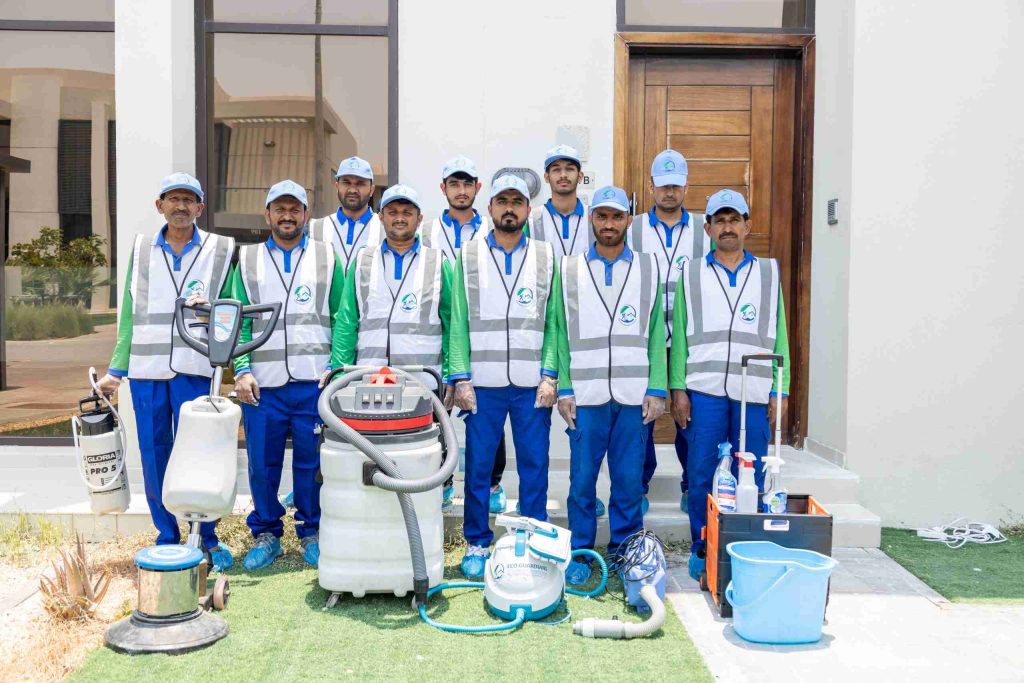
Eco Guardians is a Dubai Municipality-approved cleaning company with over 10 years of experience and 60,000+ customers served across Dubai, Sharjah, Abu Dhabi, and Ajman. Our approach to nursery and school clients is built around the zoned, multi-regulator framework described above, not a single generic cleaning visit.
Services relevant to nurseries and schools include:
- Deep cleaning services, suited to termly holiday deep cleans
- Office and commercial disinfection, adaptable to classroom and shared-area protocols
- Pest control, using child-safe application timing and documentation
- AC duct cleaning, relevant to indoor air quality in classrooms
- Water tank cleaning, a Dubai Municipality compliance requirement applicable to any facility
Compliance and Regulation
Which authority regulates nursery cleaning standards in Dubai? Four bodies intersect: KHDA covers the education permit and premises safety including chemical storage, DHA covers the clinic and health side, Dubai Municipality covers general cleaning and food hygiene, and Civil Defence covers building safety standards that affect storage and ventilation.
What is the difference between cleaning, sanitizing, and disinfecting? Cleaning removes dirt and some germs using soap and water. Sanitizing reduces germs to a safe level, and is the correct method for anything a child might put in their mouth. Disinfecting kills germs on hard surfaces using a registered product and is not intended for mouthed items.
Can disinfectant be used on children’s toys? Only for toys that are not mouthed, and even then a food-contact sanitizer is preferred for anything used by young children. Items that go in a child’s mouth should be sanitized, not disinfected, and ideally run through a dishwasher or washed with soap and water first.
What cleaning chemicals are considered safer for nurseries? The EPA has identified hydrogen peroxide, citric acid, L-lactic acid, ethanol, and isopropanol as safer active ingredients, associated with lower risk of triggering asthma or skin and eye irritation than harsher alternatives.
How often should a nursery classroom be cleaned? Daily cleaning covers high-touch surfaces and toys. Weekly cleaning should include soft furnishings and storage areas. A full deep clean during school holidays covers areas not accessible during term time.
Does KHDA require specific storage for cleaning chemicals? Yes. KHDA’s premises standards call for hazard-free storage of cleaning materials, meaning locked, out-of-reach storage with Safety Data Sheets available for every product.
Who handles illness outbreak cleaning in a nursery? Cleaning staff handle the physical disinfection following isolation, while a DHA-registered nurse in the nursery’s clinic manages the isolation protocol and health response for the affected child.
Do Dubai schools need a different cleaning standard than nurseries? The underlying regulatory principles overlap, but nurseries have additional DHA clinic requirements specific to very young children, including daily wellness checks and isolation protocols that schools for older children do not carry in the same form.
Is fragrance in cleaning products a problem for nurseries? Yes, for many children. Strong fragrances are a common asthma and sensory trigger, which is why fragrance-free or low-fragrance products are recommended for child environments even when a scented product is otherwise EPA-registered.
How do I know if a cleaning company understands nursery compliance requirements? Ask which active ingredients they use, whether they separate sanitizing from disinfecting for mouthed items, how they handle chemical storage, and whether their schedule accounts for daily, weekly, and termly layers rather than one flat routine.
Should nappy changing areas be cleaned differently from classrooms? Yes. Nappy changing areas need disinfection after every single use with a dedicated disinfectant and separate cloths, rather than being folded into a general daily classroom cleaning pass.
This guide is reviewed and updated periodically by the Eco Guardians team to reflect current Dubai nursery and school compliance standards. For a facility assessment, visit ecoguardians.ae or explore Eco Guardians‘ full range of commercial services.
References
- Knowledge and Human Development Authority (KHDA): Back to School Protocols for Face-to-Face Learning
- U.S. Centers for Disease Control and Prevention: How to Clean and Disinfect Early Care and Education Settings
- Dubai Department of Economy and Tourism: Business licensing authority